
I’ve worked with a lot of crowdfunding authors and campaign runners over the years – both directly and indirectly – and one of the key points that people get stuck on is how to craft their crowdfunder’s story. In theory, crafting one should be as easy as telling someone what you aim to make, but in practice, it can be a lot more complex. In this blog post, I’ll go into a few key items to help you craft a strong crowdfunding campaign story element, give some ideas for what to stay away from, and hopefully, by the end of it, you’ll have a stronger idea of what to write to convert as many visitors as possible.
The KISS Principle: Keep it in your mind
The KISS Principle, an acronym that found its roots in American english around 1938, stands for “Keep It Simple, Stupid.” While it’s not very nice to call people stupid, even if it’s referring to yourself, we can change this a little bit for our needs. Let’s call it: Keep It Super Simple. Same acronym, same general meaning. Think of it this way.
KISS should be applied to most things, especially when sales or leads are involved. The more simple you can present your core product, the more success you will have in actually selling it. Elevator pitches are a thing, because they’re simple distillations of a larger-swath product or story! Looking at the KISS principle in marketing often means removing barriers that would prevent someone from purchasing your product. In this case, prevent backers from backing your campaign. While you can’t put more money in a potential backer’s bank account, you can instead add links where links are expected, explain things in a simplistic manner, and guide the way through narrative and visual storytelling.
Ideally, all of this centers around your core product being a simple product.
So, with this core principle in mind, you will want to begin penning out what you’re trying to convey.
The key points
Any crowdfunding campaign should tackle some key points:
- What are you crowdfunding?
- What do you need to make it happen?
- Why do you need that much?
- What does a backer get when they decide they are invested in your crowdfunder?
- When does the backer get these items?
What are you crowdfunding?
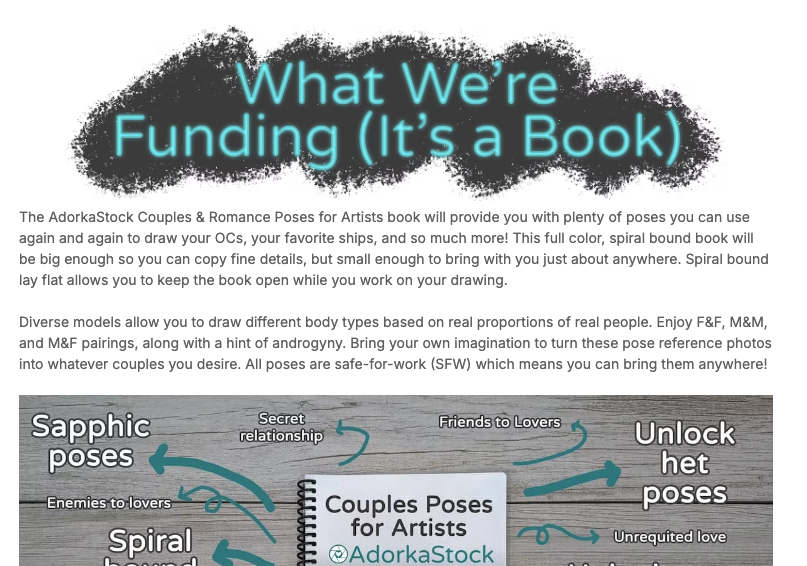
Arguably the most important bit of your story, you will want to always promote what it is first and foremost for any story. The it should be in your visuals – in your OpenGraph and hero images, in your social assets, anywhere you can show it off – because visual graphics will be the first thing people see and associate with your campaign. If your it is a book, for example, mocking up the book to look like a book (even if you don’t have a cover yet) is paramount to convincing your audience “this is a book” without even typing a word about it.
For your textual content, you will want to describe what the it is, exactly. In our example of a book, we will describe what’s inside of the book – if it’s a story book we’ll explain perhaps the plot or synopsis of the book and/or highlight some tropes – and what the book’s format is (i.e. ebook, paperback, hardcover) along with its dimensions (or file type if it’s an ebook). This is our product. This is what we’re crowdfunding.
Tip: Allow the backer to become invested in you as a person. Be silly, give asides, let your personality show through and really show them who you are as a human being. A slightly less polished/professional campaign will look more human than corporate… People love backing the “little guy”, so make sure they know that you are one!
What do you need to make it happen? Why do you need that much?
Now, the answer here is always “money”, but there’s a difference between asking for $400 and $4,000, and the bigger your goal number, the more people will ask what those funds go towards.
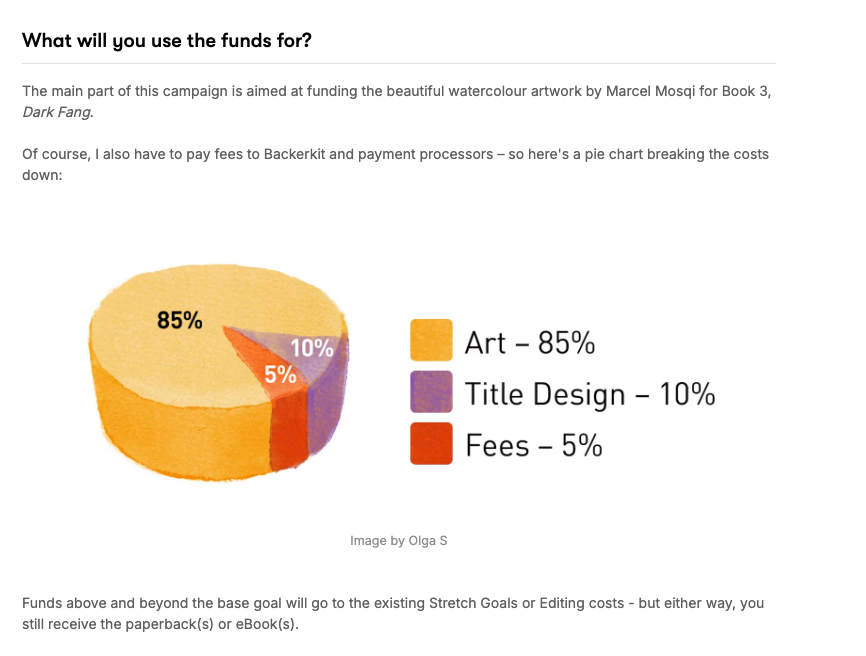
In our case of a book, we will say our goal of $400 covers 100 paperback copies, including printing and shipping. Sometimes, it will be this simple! Yes, an audiobook does cost $4,000 to produce, for example. Many times your costs won’t be this simple. Providing a breakdown of estimated costs and expenses will help people understand how much everything costs and why you’re asking as much as you are. Many people create pie charts or simply list out their expenses later on in their campaign.
What does a backer get when they decide they are invested in your crowdfunder?
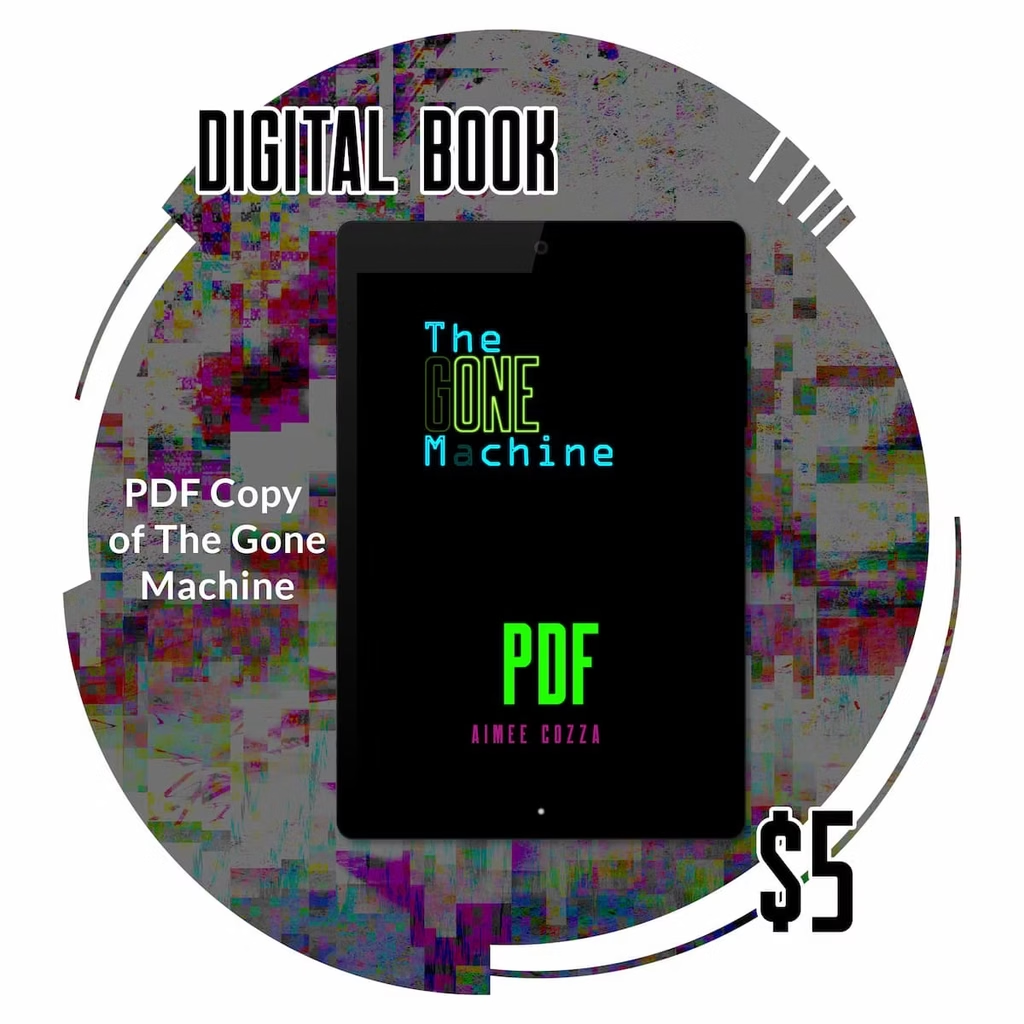
This one is easy. If a backer pledges for your campaign, what do they get in return? Sometimes they don’t get anything – they just get acknowledgments – but more often than not, physical rewards are what happens when a crowdfunder hits its goal. So, what are they getting?
In the case of a book, we would give our backers the option of receiving the book in any format of their choosing. This is our core product and what we want to promote. You may be offering more things, such as add ons or special rewards to help plump up the number of backers you will receive, but remember that your core product should always come first. If you end up having more reward tiers that don’t include the core product in some way, then you are likely shifting your focus too far away from the core item… KISS, remember?
When does the backer get these items?
Crowdfunding projects are a promise of future items. Sometimes that future item is right after the campaign ends, and sometimes it can take years for a campaign to fulfill. It is without question that you need to convey, to the best of your ability, how long your crowdfunder will take to finalize and begin fulfilling. Delays almost always crop up, but if that’s the case you’ll take to the updates to let people know about those. In the meantime, come up with a good timeline with some wiggle room worked in, and then assure people you will try to complete fulfillment by that time period. Over-conveying when you fulfill isn’t a thing – the more you tell people, the more it will stick.
Now what? How is the information structured?
There are many ways you can structure your campaign to convey your key points, but as you go through your story, you will want to make sure you’re saying enough without saying too much. This is a tricky line to balance on. Start writing. Say as much as you think you need to say, then take a look at it. Is it six lengthy paragraphs of text?
There is a joke I use a lot, and it’s “people don’t read.” Even when selling a book which is, of course, an item made for reading, selling that book means striking a balance between words and visuals. People do read, in the literal sense, but when people start scrolling social media, people don’t read. We have precious seconds to make a lasting impression and draw in a potential backer. Paragraphs of text aren’t going to do it most of the time. People read the first half of a sentence and judge from there if they want to read more.
We can work through this by giving plenty of visually interesting things to look at.
When writing a crowdfunding campaign, you’ll want to work across the entire suite of text formatting that’s available to you. Bold, italic, and underlined text are usually generally available, as well as bullet-point unordered lists. Some heading options may also be available, but please be careful to use these as intended as they are also an accessibility device, not a “make text larger” tool.
When you’ve exhausted the full suite of text formatting tools, you’ll want to turn to visuals to help break up your paragraphs of text. Images will give you more room to switch up fonts and use brand colors than you will ever get on the campaign itself, plus it gives you all kinds of neat ways to showcase the aesthetic of your project.
Ideas for campaign visuals
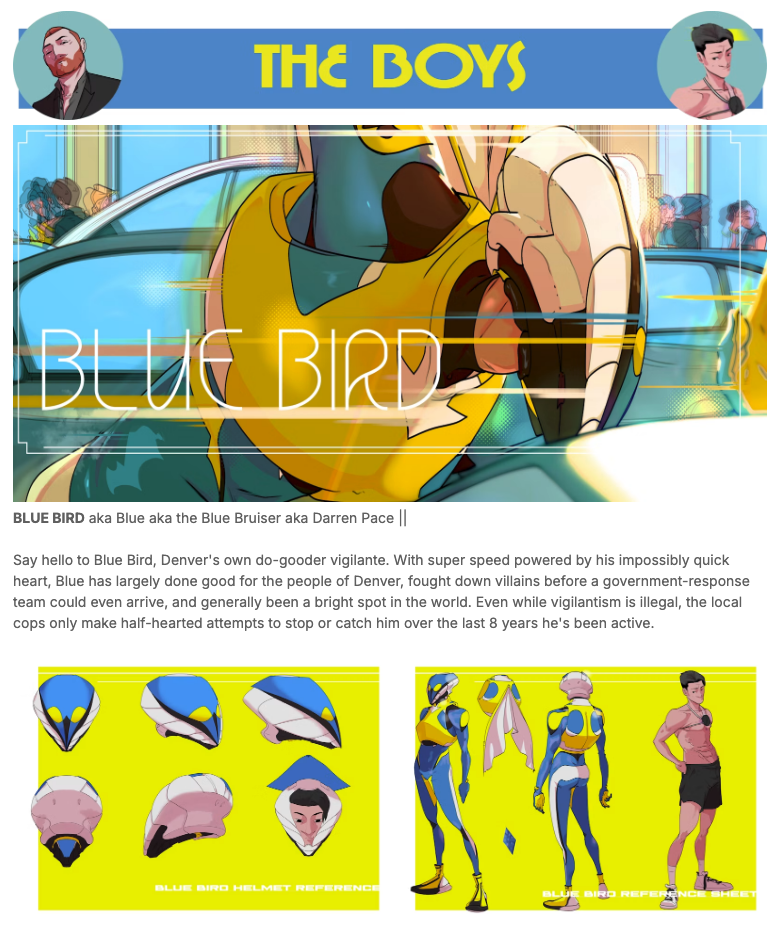
Here are some great ideas for visual elements you can create to supplement your textual content:
- Header elements
- Separator elements
- Product images including inside and outside of the product
- Quotes or excerpts
- Reviews
- Photos of you/people involved in the project
- Character or item artworks
- Size references (i.e. for a pin, you may want to show a ruler next to the pin to give a good expectation of the size of the finished product)
- Badges related to your campaign including award badges
Finding the balance… even with CTAs
There is such a thing as too much text, and also a thing as too many images. Striking the right balance between text and images is something you’ll know when you see it. An all image campaign that is 100% images will be lacking in accessibility features, and, even if the alt text is loaded and accurate, may not convey to backers and search engines alike what your project is and what it’s about. This is why I don’t suggest 100% image campaigns. Your campaign should be understandable even if something happens where the images don’t load in… And sometimes that might happen if the crowdfunding platform is having issues or your backer has bad wifi/service!
Generally speaking in the easiest sense I can explain it, I believe that per 3-4 inches of text, you should consider adding a visual of some sort. Even if it’s just decorative, having places to pause your eyes will help when backers are absorbing what you have to say about your product.
That also stands to mention that you should try to get some sort of link back to your tiers repeatedly. Like having a CTA (call to action) button on a landing page – often and easy to find – your elements, visual and text alike, should also link back here and there to the first place people should go if they feel like they’ve heard enough and want to back your campaign.
For example, if you’re explaining your rewards, you may want to link an image about your reward to its appropriate pledge tier. In the text, you may say something like “if you pledge now” with “pledge now” being a link. Even though most modern crowdfunding sites have pledge buttons that follow as you scroll, people who are really honed in and interested in your campaign might not think to even see the giant blue button at the bottom of their screen… Give them the link to click on as an additional failsafe.
Final Note
Crowdfunding changes. What was once “in” or the only way to go about doing something can change based on what a platform is providing now. As the landscape changes, you should keep up to date on reviewing what modern campaigns are doing well and doing poorly. Even if you’ve done 20 successful campaigns, re-assessing the way you’re presenting your campaigns by comparing to another successful campaign can help you come up with new ideas for bringing in new customers rather than relying on your old audience.
I would suggest anyone who is interested in building a good crowdfunder to start looking at recent campaigns in their space. For example, if you’re building a book crowdfunder, start looking at what other authors are doing for their campaigns. Doing a board game? Look at what other board games present so they can sell copies. Any successful campaign requires a little bit of research. You can also ask your friends for particularly notable or memorable campaigns they might’ve backed so you can see what made that crowdfunder seem so special.
I hope this post helped you think about how to structure your crowdfunding campaign. Happy funding!