I looked at 200+ artist portfolios. Here’s what I learned

I looked at 200+ artist portfolios. Here's what I learned

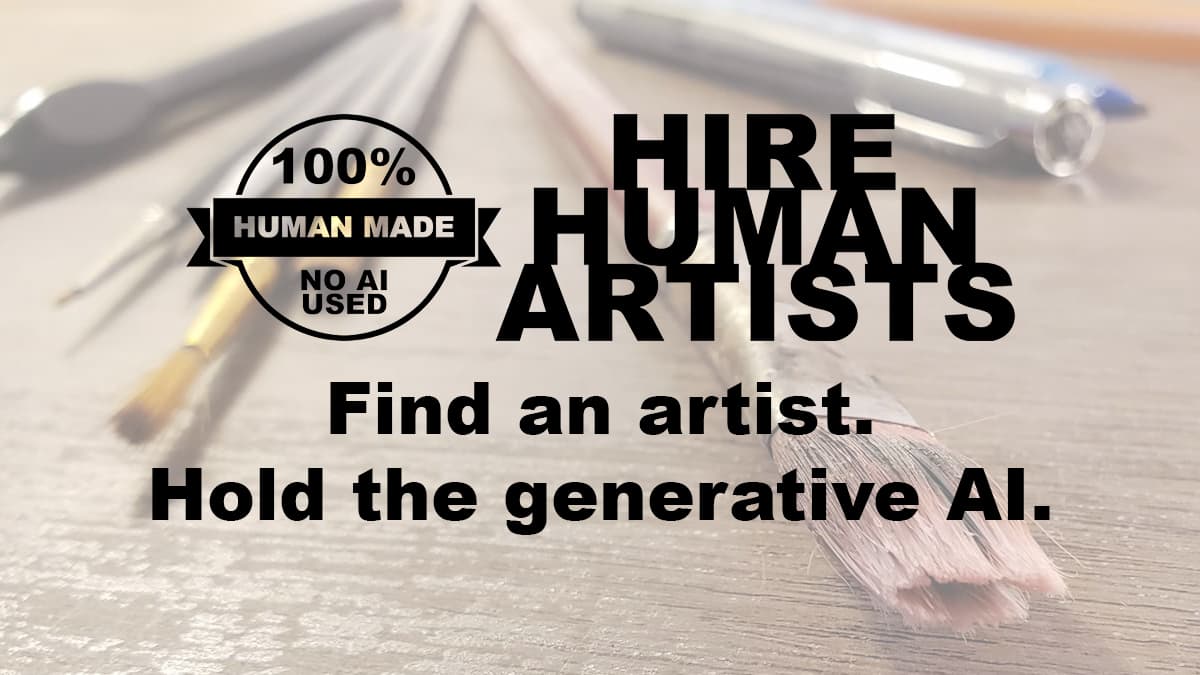
As some of you may know, I recently started up HireHumanArtists.com, a directory spreadsheet of artists who have pledged to never use gen AI while creating their works. This comes with a small caveat: someone has to review all of the submissions to see if any immediately identifiable gen AI is present in the artist portfolios. Thankfully, I have help. There’s a small group of us going through the “slush pile” of artist portfolios submitted. Still, to keep confidence in artists on the list high, we ask for a voting consensus of four people to approve each applicant at the least. Currently, there are 344 artists on the list (and growing). I’ve looked at the vast majority of the portfolios sent in, and I thought I’d note what I’ve learned, what I’ve seen, and what you may want to take away from all of these portfolios I saw.

Continue reading “I looked at 200+ artist portfolios. Here’s what I learned”

Decluttering your marketing to make better sales

Decluttering your marketing to make better sales

As a creative myself, I tend to work with a lot of creatives. They’re some of the best people – big ideas, great thoughts, unique offerings. Yet, there is an issue I see cropping up with creatives again and again, and we really need to talk about it.

I don’t have a term for it, but I think for the purpose of this article, I’m going to call it service and marketing cannibalization.

Oh, that sounds dreary. Horrible, frankly. But it’s accurate! The short form is: when you put out so much marketing efforts that actually conflict with your other marketing efforts, that you confuse your audience and leave with no money/sales/what-have-you when you could be landing those sales.

Let’s take a look at what I mean and how you can avoid falling victim to this.

Continue reading “Decluttering your marketing to make better sales”

Opinion: Is the use of AI worth it?

Opinion: Is the use of AI worth it?

It’s really hard opening emails, social media, or really anything today without being inundated with AI. AI, is, of course, a short-hand acronym for Large Language Models (LLM). Despite the widespread knowledge of the impact on everything from media to the human brain, many people are still blissfully unaware of a lot of things happening in the AI sphere and don’t know how detrimental this tech, in its current form, actually is.

It’s hard to imagine that just a few years ago this technology was in limited use; we had seen drips and drabs of what would eventually come to be full-fledged LLMs like Gemini or ChatGPT in forms like Google Lab’s Between the Lines or even MidJourney. These tools were either not open for public use or had specific use cases, rather than this all-out AI integration we’ve seen today. As one who never shies from at least trying out a new technology, I tested DALL-E early on to see how well it could generate things like my artwork from my alternative text (essentially, testing my alternative text), as well as the reverse, how well it could generate alt text from an image, and at the time, the results were disastrous and laughable at best.

Nowadays, the technology itself is improving. When once we could immediately tell when AI was used in the generation of an image by the amount of fingers and teeth a human being would have in it, changes to algorithms have made a lot of AI art and writing nearly indistinguishable from an amateur artist or a clumsy writer. Many of us can still tell, however, but I don’t imagine that will last for long.

For many of you I am telling you things you already know, but this post is for the people who don’t know, who have somehow still skirted past all of the red flags about AI and its usage, and the way the technology is being force-fed to us en masse. So, let’s get into it, and I’ll link as much as I can as sources so you can see exactly what I mean. Here’s why, long form, you should think twice about utilizing AI:

Continue reading “Opinion: Is the use of AI worth it?”

“Fancy Fonts” and using unicode characters on social media

"Fancy Fonts" and using unicode characters on social media

If you’ve been on the web for a while, you may remember the MySpace days. MySpace, preceding Facebook, was a home where you could connect typical social media style with friends, but one of the key factors of MySpace was that your profile was a little home base you could customize to your heart’s desire… To a degree. You could place all kinds of cool code to give your profile a background image, or make it play a song when someone arrived at your profile. Users could concoct really unique experiences from profile to profile.

Places like Facebook, Twitter, and others homogenized the whole experience, and with good reason; really, no one loves to have Green Day blast at them when they open someone’s profile, and then wait five hours for all the moving and flashing animated gifs to load. Plus, all the ability to customize nearly fully meant MySpace profiles could be a vector for delivering malware, spyware, and more. Allowing users a small level of customization rather than a vast all-inclusive customization experience meant it was easier to browse as a whole.

Now, in 2025, we’ve got a whole lot of homogenized social media. It can be difficult to customize your profile or stand out in a crowd of many when almost all profiles look the same, barring the profile picture, header graphic, and actual copy.

Why did we go down this quick trip down memory lane?

Because today I’m going to be talking about “fancy fonts” in use on social media, what they are, and how they affect other users.

Continue reading ““Fancy Fonts” and using unicode characters on social media”

Accessible Marketing: Avoiding Mystery Meat in your Marketing Efforts

A loaf of questionable meat product cut into slices laid on a plate.

You may be familiar with the concept of “mystery meat”: A “meat” product, usually some sort of salisbury steak or meatloaf type deal, usually served in American cafeterias. People usually don’t really know what’s inside this meal: they know it’s some sort of meat, but they can’t pinpoint what exactly just by looking at it. I’ve been referring to vague navigational beacons as “mystery meat navigation” for many years, thanks to a coining from an ancient website I believe was YourWebsiteSucks.com (I can’t seem to unearth it now; it could have been WebpagesThatSuck.com but I was pretty sure at the time it was more pointed than that). The same concept can be used to describe nebulous marketing concepts.

So, what is a piece of mystery meat in the marketing sphere, and how do we avoid it?

Continue reading “Accessible Marketing: Avoiding Mystery Meat in your Marketing Efforts”

Happy one year anniversary, Foundation!

Happy One Year Anniversary, Foundation!

Happy one year birthday, Foundation Web Design & Development! That’s right. It’s officially been over one year since Foundation Web Design & Development was incorporated. Officially, Foundation was filed as an LLC in September of 2023, but I didn’t start full-time work until mid-November, and finally got around to making this post now. So… Happy belated birthday Foundation! And here’s what I learned over the last year:

Continue reading “Happy one year anniversary, Foundation!”

Is Bluesky a place for businesses and brands?

Is Bluesky a place for businesses and brands?

With the latest controversy regarding Twitter and its slow, painful demise, many people have signed up (about 12 million to be exact!) on Bluesky as a replacement platform. While Bluesky is functionally more or less the same kind of platform as Twitter – posts are organized the same and behave mostly the same – Bluesky is an entirely different platform with a curated “feel” to it. You may be wondering if this is the next place for you to pitch your business, brand, or services. Let’s go over what you should know about Bluesky to decide whether or not you should try to utilize it for your business.

Continue reading “Is Bluesky a place for businesses and brands?”