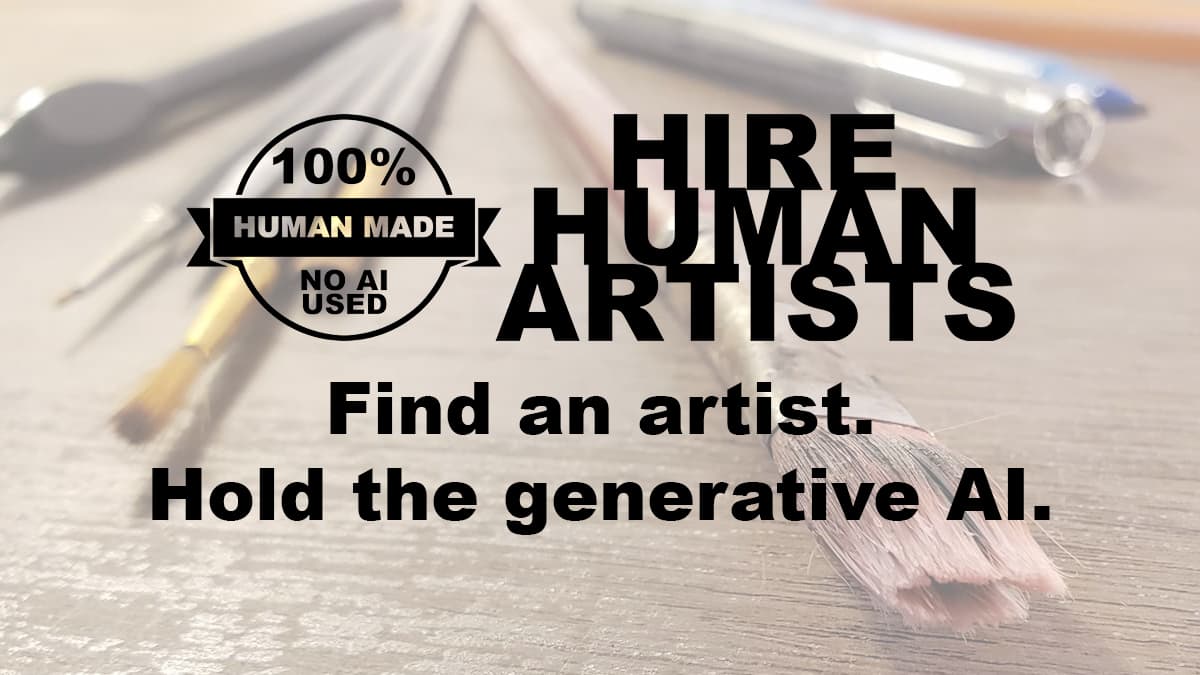
Introducing: HireHumanArtists.com… an easy way to find artists who have declared they do not and will not use generative AI in the creation of their artworks.
Continue reading “Introducing: HireHumanArtists.com”Opinion: Is the use of AI worth it?
It’s really hard opening emails, social media, or really anything today without being inundated with AI. AI, is, of course, a short-hand acronym for Large Language Models (LLM). Despite the widespread knowledge of the impact on everything from media to the human brain, many people are still blissfully unaware of a lot of things happening in the AI sphere and don’t know how detrimental this tech, in its current form, actually is.
It’s hard to imagine that just a few years ago this technology was in limited use; we had seen drips and drabs of what would eventually come to be full-fledged LLMs like Gemini or ChatGPT in forms like Google Lab’s Between the Lines or even MidJourney. These tools were either not open for public use or had specific use cases, rather than this all-out AI integration we’ve seen today. As one who never shies from at least trying out a new technology, I tested DALL-E early on to see how well it could generate things like my artwork from my alternative text (essentially, testing my alternative text), as well as the reverse, how well it could generate alt text from an image, and at the time, the results were disastrous and laughable at best.
Nowadays, the technology itself is improving. When once we could immediately tell when AI was used in the generation of an image by the amount of fingers and teeth a human being would have in it, changes to algorithms have made a lot of AI art and writing nearly indistinguishable from an amateur artist or a clumsy writer. Many of us can still tell, however, but I don’t imagine that will last for long.
For many of you I am telling you things you already know, but this post is for the people who don’t know, who have somehow still skirted past all of the red flags about AI and its usage, and the way the technology is being force-fed to us en masse. So, let’s get into it, and I’ll link as much as I can as sources so you can see exactly what I mean. Here’s why, long form, you should think twice about utilizing AI:
Continue reading “Opinion: Is the use of AI worth it?”The Great Migration – Moving from WordPress dot com to Self-Hosted
When parent company Automattic announced just a few days ago that they were going to be selling user data from WordPress.com and Tumblr to Midjourney (Company responsible for LLMs), at first I just shook my head. I read the details, including the grisly fact that all user data has likely already been scraped and sold, including private data like unanswered asks on Tumblr and private blogs, and put it aside for a moment. Later, a paltry toggle switch to opt-out WordPress.com and Tumblr accounts (despite the data likely already being taken) appeared, and I thought: no.
Continue reading “The Great Migration – Moving from WordPress dot com to Self-Hosted”How to edit your Shopify robots.txt file to block AI Crawlers
So… You want to add some of the information to block AI crawlers from continually scraping your data. Easy enough with a WordPress plugin, and Squarespace has a toggle, but what about Shopify?
The help center document on their robots.txt file seems very daunting. Especially with that big ol warning about losing all of your traffic. But I assure you, it’s actually very easy to do, and very easy to revert if you’ve done it incorrectly.
Continue reading “How to edit your Shopify robots.txt file to block AI Crawlers”Which web crawlers are associated with AI crawlers?
While initially building out my Simple NoAI & NoImageAI plugin for WordPress, a meta directive was all we had at the time. Now that crawlers are using robots.txt to determine whether a site has opted in for web crawling, more well-behaved crawlers are looking for them. Therefor, it’s important to have a list of crawlers, what they’re noted to be used for, and their user agents in case you want to block them.
This information as of Oct 1st, 2025 is up to date, but may change. I will try to keep this list updated as much as I can. Information on this list is also supplemented by Cloudflare’s list of blockable AI crawlers.
Continue reading “Which web crawlers are associated with AI crawlers?”Utilizing Robots.txt to Block AI Crawlers
Here I am, back again to pass along some knowledge on how to protect you and your art against generative AI. In fact, I’ve got a few posts happening now, and I’m sure more will come as the technology evolves, so I’m going to start a new category for blog posts under “protecting your art“. You can always subscribe to get blog updates from me if you’re interested in hearing more about these things as they emerge.
Today I’m going to teach you a little bit about the inner workings of web crawlers and how to utilize a robots.txt file to block certain crawlers from accessing your website.
Continue reading “Utilizing Robots.txt to Block AI Crawlers”What is DeviantArt’s new “noai” and “noimageai” meta tag and how to install it
Yesterday, the internet was taken by storm by DeviantArt’s announcement of some new services and features. Many people focused on the fact that DeviantArt announced an AI generator of their own, and that by default, images uploaded to DeviantArt were opted in to being allowed to be used for AI training (though not specifically DeviantArt’s AI called “DreamUp”). DeviantArt has since reversed its stance on opt in (now making opt out the default, which should have been the case to begin with), but there were a lot of different, loosely related ideas that were part of this announcement that, unfortunately, were missed. One of these is the release of the “noai” and “noimageai” meta tags, which will help you have more control over whether or not your art is used to train AI image generators.
Continue reading “What is DeviantArt’s new “noai” and “noimageai” meta tag and how to install it”