
There’s no other way to phrase it. Simply put: the internet is in trouble.
It has been for a while now. But this time, this year, the internet feels like it’s more on the verge of collapse than ever before.
I don’t mean that the internet is just going to cease to be, I’m doubtful something so sudden like that will happen, but the internet as you know it and as you use it is more or less done.
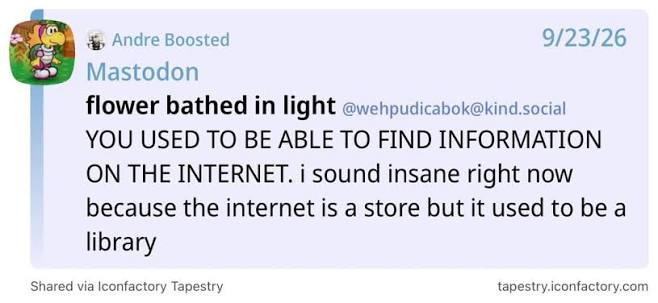
This toot sums it up succinctly and perfectly:
Capitalism sure has run its course on the internet, but it’s somehow worse than that, and just this week I’m not feeling great and hopeful about it.
The question is how do I pen up my thoughts about the state of the internet? There are a lot of them, and they don’t wholly slot together neatly with easy, catchy headers you can flip to. So let’s start with this week and what’s going on.
This week I received an email from my hoster, letting me know they reset every single password of every FTP user on my account. I have never seen this happen before, and can only assume it was a pre-emptive attempt to stop some sort of exploit from happening. It’s still not explained what happened to prompt this.
Last week we had PHP2Shell, a catastrophic PHP exploit that had been known about since 2024, had not been patched due to the issues of all patches having pretty significant side effects, that had begun to gain traction amongst exploiters. While diligent groups of people worked fast to contain and prevent exploits while waiting on a patch, many people were unaffected, but the reality is that PHP2Shell affects a vast swath of the internet. Many websites may never get the patch and may be exploited and/or defaced, and we may never know the loss that happens there until it is far, far gone.
And before that? More WordPress security updates than I have ever seen drop in such a short period of time. WP2Shell in July. 7.0.3 in August. Followed by 7.0.4 a week later. 7.1.1 in September. 7.1.2 a week later. 7.1.3 a week after that.
This is not coincidental to the rise of AI agents. The general public has access basically 24/7 to a bit of powerful code with loose “guard rails” that can engage in all manners of destructive behavior. I’m not sure who said it, out of the many articles I’ve read about this, but more or less most website owners are “one bored teenager away” from being hacked, exploited, and/or defaced. We’re seeing a deluge of people who never had the knowledge or means to do nefarious things like… oh, I don’t know, try to perform a SQL injection, now suddenly have the ability to let a torrent down on anyone or anything out on the web.
AI agent and bot attacks are happening in the tens of thousands per hour. AI crawlers are consuming pages at a rate that’s causing seasoned web owners bills in the thousands of dollars while also considering taking their life’s work offline. The rest of us are trying to thwart these incessant attacks and vast resource consumption by tweaking settings in firewalling services like Cloudflare (who touts AI/bot control and AI integration in the same breath) on the daily while our real website human visitors get hammered with server timeouts and unexpected errors.
I can see this going the following way: companies who can afford to bolster their security and the bandwidth being eaten up by AI crawlers will thrive, while everyone else – all of the mom & pop, small business, single entrepreneur businesses – will be destroyed. Small biz will be pushed to a handful of services (i.e. Squarespace, being able to handle the visitor bandwidth, or maybe Shopify is less hackable than a self-hosted install, or perhaps to a social media site) and then from there, competition is squashed and rates. Go. Up.
It’s not just about AI, of course, because now we’re talking money as well, and it’s always about money. Services that have historically been free are now charging money (but famously, coming off like a “poor tax”), like Draft2Digital that is charging a yearly fee of $12 for anyone who doesn’t make $50 or more in royalties. D2D’s fee is definitely because of the onslaught of low-quality AI slop, which they state here:
Like many platforms, we’ve seen a significant increase in automated and low-quality account creation in recent years. This onslaught from automated content farms threatens reader trust in indie titles and risks indies being associated with low-quality “slop.” A modest activation fee can make a real difference and allow our team to stay focused on supporting genuine authors like you.
But we also have places like Meta that, after building your social media presence for twenty years, now want to charge you $49.99 to post up to 8 links a month (you get 2 on a free account) oh yeah and illegally claim possession over the content on your own website and use it to train AI if it’s ever referred to by anyone at all on their platform. It’s easy to smugly say “get off Facebook”, but after being urged for years to craft your presence on Facebook, Instagram, and now Threads, the choices for where to go to reach the swath and variety of people (and the audience that you worked so hard to gather) is dwindling. “Just go to Twitter,” some might say, and your correct response is “Can’t, it’s full of nazis.” So maybe they’ll say “Just go to Bluesky,” and you say “Well, the worst thing there is the owners hate the users they’ve attracted, routinely make bad policy decisions that affect minority populations negatively, and the owners are all in on utilizing AI to vibe code their way out of everything, so maybe?” And we keep kicking that can right on farther down the road.
The internet looks dire for people like you and I, even if you’re not running a small business. Your online spaces are infiltrated with nosey AI like Gemini trying to take over your perfectly fine working Assistant or trying to get you to use it in Google products. You can’t even have Discord open for a few hours without an intrusive ad popping up in your face that you have to click to close. The unceasing torrent of laws coming about in every country, touting “internet safety” for children as the reason behind them (but have demonstrably not done any of that), lean heavily into censorship and thought-policing. Age verification is everywhere. Anonymity is more or less gone from the internet as a whole for the standard user, yet the nefarious user can routinely weaponize slow-to-respond platforms with spotty policy and moderation enforcement to do harm to real people that aren’t necessarily doing anything particularly wrong or bad. Furries, sex-workers, LGBTQIA+, BIPOC, and neurodivergent folks who have historically found safety in the confines of the internet (and are often the backbone of the internet to begin with) are finding their own spaces turning hostile against them. What are we even doing here?
Algorithms built to feed us negative things and keep us doomscrolling with ragebaiting. We’re tucked tightly into this box of fear and are fed bit after bit of anxiety and stress inducing news that keeps our brains in a panic spiral so we don’t get a moment to breathe. It’s by design, and it can be stopped at any time, but unfortunately, no one wants to stop it.
I can’t even segue seamlessly into the next thing because there’s just so much. Facebook ads used to be a great boon for small business owners to get their service offerings out there without paying thousands of dollars – even a $50 ad could get you something – but now it’s full of bot clicks by the thousands with little for conversions, so much so that I won’t suggest anyone to use it. Users are sick of being advertised to at all times; Tumblr users ignore Blazed posts most of the time if they’re selling anything at all (even though most of the times those are from people within the community they should be supporting), Imgurians have found a way to block all ads on skeleton site Imgur, and Google ads (which also controls YouTube ads) are so convoluted that it’s easier to hire a professional than to try to figure out how to work your way through it… Except for this 9 year old who spent $118,000 of his dad’s money on YouTube ads for his channel, he’s apparently got it worked out. But I’m finding out now this was actually a grift, and you get to hear how I learned about that in real time.
Yeah, that’s the other thing, everything on the internet is a scam now, and everything is fake. Bunnies jumping on a trampoline? Aw how cute – it’s fake. Dogs at a shelter “picking” their own human? Adorable, but fake. Baby peacocks don’t look like that. No, a wildly photogenic crying child and a puppy weren’t left stranded in the middle of a flood. “Pics or it didn’t happen” isn’t a thing anymore when anyone can make convincing looking slop. Interviews with AI people over video calls may or may not be real, depending on the circumstances, but throw a massive red flag. Scammers are using generative AI to swindle your loved ones out thousands of dollars so much so that security advocates are advising people to make safe words for their families in the chance of voice cloning and deep faking.
“The Party told you to reject the evidence of your eyes and ears. It was their final, most essential command.”
George Orwell
Don’t click on that link, it’s a phishing attempt! Don’t open that email, it’s a phishing attempt! Don’t open that text, it’s a phishing attempt! Don’t answer that call, it’s a phishing attempt!
And the worst part is that almost all of us remember a better time when the internet wasn’t like this. It was never a gloriously green meadow of perfection, but we had free streaming without ads. We had chronological timelines on social media. We could post as many links as we wanted without being punished by some algorithm. We could search “[sitename] coupon” and discover a coupon code that would work for the place we were ordering from and feel good about it. Ordering from Amazon meant you did get free two-day shipping. We didn’t have to second guess every single video or piece of artwork posted on the internet because it was either real or a really, really good photoshop that was worth the “bravo” for the big knowledgeable effort of actually looking real. Restaurants were posting photos of their food instead of… whatever the hell this is. I guess you really don’t know what you’ve got until it’s gone.
I hate to end this without a hopeful note, but I unfortunately don’t have one. This looks bad. Worse, it looks dire. And I can’t seem to get my head around any ways to pull back from it to recover some of what we lost. It all feels so hopeless and crushing every day you log on and start scrolling.
The only advice I can give to you is: log off sometimes. Go find a pretty leaf on the ground and pick it up. Connect with your community in the real world and try to make a difference there. And maybe, if you’re like me, you’ll realize the world actually isn’t that hopeless, even if it’s only for a second or two at a time.